Ironman Rules Explained: Avoiding Penalties

Ironman Rules Explained
Nothing stings quite like losing time to a rule you did not know you broke. You can train for a year, arrive in peak shape, and still hand back five minutes in a penalty tent because you sat too long behind another rider. Ironman is a largely self-officiated endurance race with real rules and real referees, and the athletes who race smart treat the rulebook as part of their preparation rather than an afterthought.
Here is a plain-English guide to the rules that matter most, where penalties come from, and how to stay clean on race day.
One note before we start. Ironman updates its competition rules regularly, and some details vary by event and by region. Always read the official athlete guide and current competition rules for your specific race. Treat what follows as working knowledge to keep you out of trouble, then confirm the exact figures for your event.
Ironman Swim Rules
The swim is the most relaxed leg in terms of rules, but a few things still matter.
Wetsuit legality depends on water temperature. For age-group athletes, wetsuits are generally allowed up to around 24.5 degrees Celsius (about 76 Fahrenheit). Above that, they may be banned or allowed, but they make you ineligible for awards and qualifying slots. Professionals face a lower cutoff. Wetsuit thickness is capped at 5mm, and you cannot use swimming aids like fins, paddles, or snorkels that give you an advantage. Wear the official swim cap you are handed.
The bike: drafting is the big one
The vast majority of penalties happen on the bike, and almost all of them come down to drafting. Ironman is a non-drafting race, which means you have to keep a set distance behind the rider in front of you. That draft zone is typically about 12 meters, measured from their front wheel to yours, roughly six to seven bike lengths. If you move into that zone to pass, you get a limited window, usually around 25 seconds, to complete the pass and move ahead. Sit in someone's draft zone without passing, and you have earned a penalty.
The practical habits that keep you legal: ride to your side of the road and do not block, pass on the correct side, and once a rider passes you, drop back out of their draft zone before you respond. You cannot pass and then immediately slow down, and you cannot leapfrog the same rider over and over.
The bike: the rules that get overlooked
Drafting gets the headlines, but these will end your day just as fast.
Your helmet must be buckled before you touch your bike and stay buckled until after you rack it again. Unclip that chin strap too early and you risk disqualification. Mount and dismount only in the marked zones, after the mount line and before the dismount line. Discard bottles, gels, and trash only in the designated zones near aid stations, because littering on course carries a penalty. And forget headphones. They are banned for the entire race.
Run rules
The run is simpler, but the rules still bite.
You cannot be paced by anyone who is not in the race, so no friend jumping in to run you home. You cannot accept outside assistance, and headphones remain banned. Keep your race number visible on the front of your body. Run your own race, on the course, the whole way.
Outside assistance and conduct
Across all three legs, the principle is that you complete the race under your own power with only the support the race provides. You can use official aid stations freely, but you cannot take food, drink, equipment, or a push from spectators or your support crew. Abusive or unsportsmanlike behavior, ignoring officials, or skipping part of the course all lead to disqualification. There are also overall and segment cutoff times, with most full-distance races giving you 17 hours to finish, so know the cutoffs for your event before you start.
How penalties actually work
Officials patrol the course, usually on motorcycles, and issue penalties when they see a violation. For drafting and similar fouls in a full Ironman, you serve a time penalty in a penalty tent, commonly five minutes, before you can continue. Pick up several penalties and they escalate, with repeated or serious violations ending in disqualification. The system is built so that one honest mistake costs you time, while a pattern of breaking the rules costs you the race.
The takeaway is not to ride scared. It is to know the draft zone, hold your position, and pass with purpose, so you never give a marshal a reason to reach for a card.
Racing smart is a skill you train
Knowing the rules is really part of a bigger skill: racing well. The fittest athlete does not always win. The one who paces correctly, fuels on time, handles transitions cleanly, and stays out of the penalty tent regularly beats stronger athletes who race carelessly. Race execution is something you can practice and plan long before you reach the start line.
That is a big part of what good coaching does. At HAX Athletic Club, we prepare our athletes to race, not just to get fit, from pacing and fueling strategies to the small details that keep you legal and efficient on the day. If you want to show up to your next Ironman ready to race smart and finish strong, the HAX team can help you build both the engine and the plan to use it.
Train With HAX
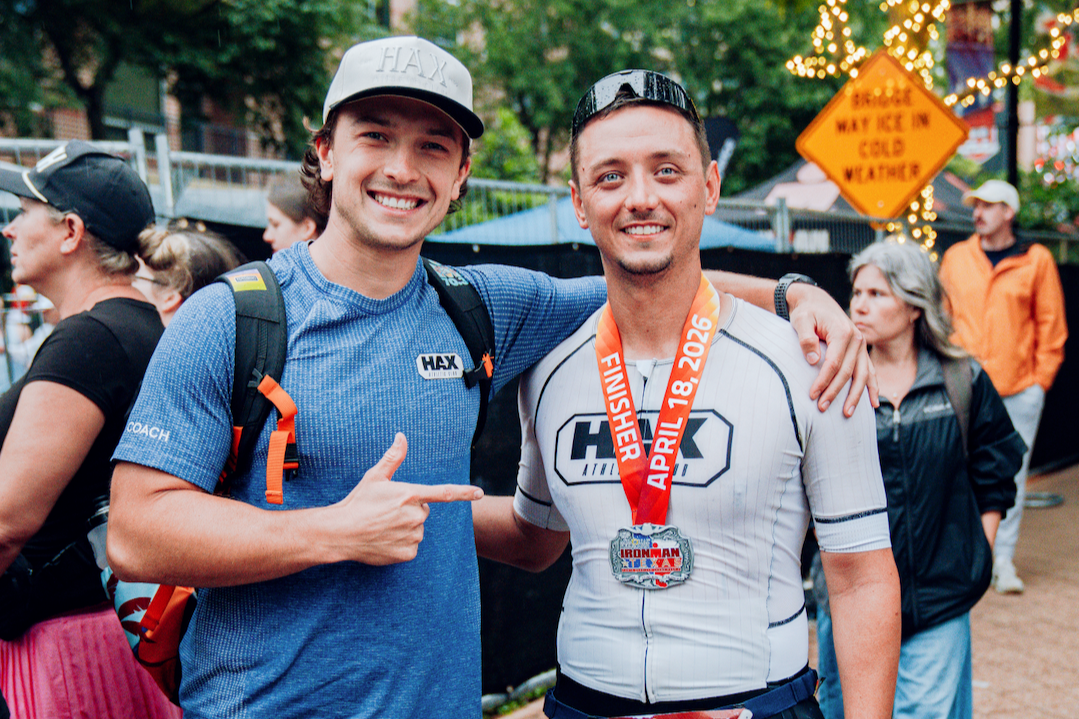
HAX Coach Blake Jacques and HAX Athlete Cole Burchett after Ironman Texas 2026
When you join HAX, you are not handed off to an app or a generic training plan. You work with a team of qualified, experienced coaches who have a genuine stake in getting you across your finish line.
HAX was founded by Blake Jacques, a triathlon coach, strength-training advocate, and Ironman athlete who has actually completed the distance he coaches. His resume includes 3 full Ironmans, 10 half-Ironman finishes, and 2 World Championship qualifications. Over 5 years of building HAX, Blake has led a team of 8 coaches and helped hundreds of athletes cross the line strong, from complete beginners finishing their first Ironman to elite age-groupers competing at the highest level.
Blake founded HAX for a specific reason. He saw a gap in the market, plenty of plans built to chase a single race result, and almost none built for the athlete behind it. So he created HAX to give athletes the right systems for longevity and performance, not just a good day in one race. That philosophy runs through everything the HAX team does, sitting right at the intersection of Ironman racing, strength training, and competitive longevity.
What that means for you is smarter coaching. The HAX team does not just pile on miles. We coach the whole athlete, combining endurance training with the strength work that keeps you durable and injury-free when fatigue hits late in a race. Your training is built on your actual physiology, mapped via INSCYD metabolic testing, so every session targets the right zones rather than guessing. And it is built around your life, your schedule, your job, your family… not a generic template downloaded off the internet.
You also get a team that knows you. With 8 coaches and a genuine community of athletes behind you, you are never grinding through early mornings and long weekends alone. When life interrupts your plan, and it will, your training gets adjusted with you rather than left for you to figure out by yourself.
HAX is focused on one thing: giving more athletes the tools to race well and hit the goals that actually matter to them. If you want coaches who have done the work, know the science, and will take your goal as seriously as you do, the team is ready to help you finish your next event strong.